Late Spring Plantings
Early spring plantings include crops like broccoli, lettuce, beets, carrots, kale, etc; crops that are frost tolerant and they do well in cool weather. It is now mid-April and for much of the west, the southwest and the southeastern United States, this is the time to be planting other kinds of crops. If the danger of frost is past then other crops can be planted.
What are late spring crops? Corn, melons, cucumbers, green beans, peppers, sweet potatoes and tomatoes are all late spring crops. So what are the considerations for planting these crops? One consideration is soil temperature; generally speaking the soil temperature should be above 55 degrees. If you don’t have a thermometer probe that you can stick in the ground to get a reading, the outdoor temperature can also tell you when it’s safe to plant. If the outdoor daily highs are in the 70s and the outdoor daily lows are 50 or above, the soil temperature will be above 55 degrees.
Corn will not sprout if the soil is below 55 degrees and if the seed sits in the ground too long, it will rot and fail to sprout. You can get around this problem by stretching a strip of clear plastic over the rows of corn you just planted. The plastic will warm the soil, the seeds will sprout, and once the seeds have sprouted, you can remove the plastic and the corn will grow without assistance.
In general, the same can be said for all the cucurbits (melons, cucumbers, etc), clear plastic is an effective way to outwit Mother Nature and gets your garden going early. But melons do not need to be planted early unless you live in a cooler, northern climate and the growing season is short. In the desert regions of the west and southwest, the growing season is sufficiently long to get ripe melons before fall—and they do well in the heat so they are an excellent summer crop; and the reward is worth the wait.
Melon Varieties
If you have prepared your soil properly, have sufficient nutrients in the soil, and planted at the right time, then the remaining question is what variety do I plant? In my experience, the variety is all important with melons. A nice plump ripe cantaloupe can be very disappointing if it tastes like cardboard and has the consistency of cardboard too. Popular varieties include Rocky Ford, Hales Best and Hearts of Gold, but these varieties all have good shelf lives, which means you will find them in the grocery stores because they will last—but the texture is hard and the flavor is mediocre. The best variety for home gardeners is Ambrosia. The flesh of this melon is soft, and the flavor is beyond anything you’ve eaten before. If you grow Ambrosia, you’ll never grow anything else.
I recommend growing cantaloupes over all other melons for a couple of reasons; 1) the days to maturity is the shortest of all the melons and, 2) there is no question about when the cantaloupe is ripe, the outside color turns from green to a soft yellow color…and the step slips off the melon. This makes growing and harvesting easy and predictable.
Watermelons are the next easiest melon to grow; they love the heat, grow fast and are a delight to eat. But watermelons are a little more challenging to know when to pick them; a) the first tendril on the vine from the melon will begin to shrivel and die and, 2) the underside of the melon will turn a yellowish white color. And the days to maturity is another way to know when to pick watermelons. There are many varieties but Crimson Sweet is one of the best, very sweet and delectable. Sugar Baby is also good, Klondike and others. You may want to experiment to see which does best in your area.
Casaba, Crenshaw and Honeydew melons are excellent melons but a little harder to grow and require a longer growing season. They also do not tell you when they are ripe, so they can be a little frustrating to grow. Also, Crenshaw and Honeydew melons tend to sun scald, which can spoil the melon. Because they take so long to mature, hot summer days can scald the exposed melon skin.
Tomatoes: Here are some tomato facts you must know and respect if you want to grow tomatoes in the desert. With low humidity (all of the southwest and desert areas of the west and Rocky Mountain areas), tomatoes will not set fruit if the night time temperature is below 55 degrees and the daytime temperature is above 95 degrees. The plant will bloom but will not set fruit unless the temperature falls within these parameters. Therefore, in certain hot climates, there is a narrow window that must be met. Tomatoes must be planted as early as possible (they have little frost tolerance), so they will grow, bloom and set fruit before the daytime temperatures get above 95 degrees. And once the daytime temperatures exceed 100 degrees, the tomato plant will be severely stressed and will perform poorly; essentially at this point your tomato harvest is over.
There are many varieties of tomatoes so it depends on what you like. Here is another truth, retailers or green house growers who tout “hot weather” tomatoes that will keep producing when it’s hot, are not being completely honest—remember the 55-95 degree principle, this holds true for all varieties except the cherry tomatoes.
Also, you should understand the meaning of “determinate” and “indeterminate” varieties. Determinate varieties will grow, blossom, set fruit but the vines will stop growing. The indeterminate varieties never stop growing; they may or may not continue to produce tomatoes but will continue to grow as long as they have water and nutrients. Thus, space becomes an issue here.
Finally, heirloom varieties seem to be all the rage, although I’m not sure why. Heirloom varieties are of poor quality, poor flavor and are unpredictable in color and shape. If you like quirky looking fruit, a novelty to show your friends, then heirloom varieties are perfect. But if you want quality, flavor and predictable shape and color, then the hybrids are the answer. Personally, I would not waste time, water and expense on growing heirloom varieties.
I am often asked what you can grow during the hot summer days. There are not a lot of good options, in the hot southwest, the 100 plus degree days stress most garden crops (except corn and melons), and although the heat may not necessarily kill the plant, it will stress it to the point that it fails to bear fruit or the fruit is of poor quality. This is why spring and fall or the best times to garden.
Thursday, April 14, 2016

Sunday, May 27, 2012
Using animal manure in the garden
Animal manure is the foundation of all fertilizer—worldwide; it is either applied directly to fields and gardens or it is processed to make bagged manure, or other forms of commercial fertilizer. Animal manure is excellent fertilizer, and an excellent source of nitrogen and other essential nutrients; but it has its drawbacks, its deficiencies, and its costs too.
Steer manure: is by far the most abundant animal manure and the most complete; it contains generous amounts of nitrogen, phosphate, and potassium, it also contains many of the trace minerals that also aid plant growth. Steer manure contains about 3-4% nitrogen by volume, when fresh. The older it is, the less nitrogen it contains. Part of the nitrogen in steer manure is in the form of ammonia, which is a gas, and dissipates into the air quite rapidly, so should be tilled in immediately.
But how do you use the stuff, and how do you apply it? One reason commercial fertilizer is so popular is it is in a concentrated form, comes in a nice clean bag, and is easy to apply; steer manure? Not so much. Steer manure is available from dairies, cattle farms and stockyards—and in bags at your local nursery. Some of these might deliver to you, but it’s likely you will have to go get your own, a major inconvenience—it might also be free, a major advantage.
As a rule of thumb, if you decide to apply steer manure to your garden, you would apply about 3-4 inches of manure on the ground, then till it in as deep as you can. This may seem like a lot of manure, and it is, but if you think about the distribution, you’re not getting a huge amount of nitrogen out of it, but probably enough. Also, only about half of the nitrogen will be released the first year, the rest, the following year. By comparison, a few pounds of 34-0-0 commercial fertilizer would equate to all this steer manure—and it is all available right now; but you get no organic matter from it.
Steer manure also contains quite a lot of weed seed that will sprout, so this is a negative of using barnyard manure. Some commercially bagged steer manure is “cleaned” and is free of weeds, but this bagged manure ends up being quite expensive; so that is your tradeoff.
Horse manure: has about 1% nitrogen, by comparison; but has more “undigested” feed in it, and if sawdust is also included, much of the nitrogen will be tied up in breaking down this material. Horses don’t digest feed as well as cows do, so much of the hay is just pushed right on through and ends up in the manure. If horse manure is used, it is generally necessary to supplement with a commercial nitrogen fertilizer…for some crops.
Horse manure also contains a fair amount of weed seed—so expect it. And horse manure is almost always free. Those with horses are delighted to get rid of the stuff—but you’ll probably have to go get it yourself. I always make friends with a couple of neighbors who stable horses, and ask if I can take their manure; I’ve never been refused yet.
Turkey manure: has a nitrogen content of about 9%, triple that of steer manure, so it is “hot” stuff, and you must be careful in applying it or you will “burn” your young, tender plants. The Moroni, Utah turkey growers sell a “turkey mulch” that mixes turkey manure with sawdust or other wood products. This makes an excellent manure/mulch for the garden—but it’s expensive, and must be trucked in. Because some of the nitrogen is tied up in breaking down the sawdust, it makes a great fertilizer and mulch for the garden.
However, turkey mulch (also true for chicken manure) has very little phosphate, potash, or the trace minerals; so what you’re getting is nitrogen and excellent mulch. But turkey and chicken manure has very little weed seed in it, so this is a plus.
Chicken manure: All that is true about turkey manure is true with chicken manure also.
Pig manure: pig manure has about double the nitrogen of steer manure, but because it contains different bacteria than other animal manure, it becomes a very slow release nitrogen and generally takes two to three years before you get all the nitrogen from it, so it is a poor fertilizer for nitrogen; it also contains less organic matter than does steer or horse manure.
Overview: fertilizer does not need to be expensive, but it can be. Commercial fertilizer is not cheap, but very convenient, and easy to apply. Turkey manure is an excellent fertilizer and compost but is also expensive. If you’re resourceful you can get all the steer manure and/or horse manure you want for free—but labor will be required.
If you choose to buy all the expensive gardening materials, you might well have $14.00 tomatoes, but if you’re resourceful you can produce the best tasting and largest tomatoes around—at a fraction of what you will pay in the store.
Steer manure: is by far the most abundant animal manure and the most complete; it contains generous amounts of nitrogen, phosphate, and potassium, it also contains many of the trace minerals that also aid plant growth. Steer manure contains about 3-4% nitrogen by volume, when fresh. The older it is, the less nitrogen it contains. Part of the nitrogen in steer manure is in the form of ammonia, which is a gas, and dissipates into the air quite rapidly, so should be tilled in immediately.
But how do you use the stuff, and how do you apply it? One reason commercial fertilizer is so popular is it is in a concentrated form, comes in a nice clean bag, and is easy to apply; steer manure? Not so much. Steer manure is available from dairies, cattle farms and stockyards—and in bags at your local nursery. Some of these might deliver to you, but it’s likely you will have to go get your own, a major inconvenience—it might also be free, a major advantage.
As a rule of thumb, if you decide to apply steer manure to your garden, you would apply about 3-4 inches of manure on the ground, then till it in as deep as you can. This may seem like a lot of manure, and it is, but if you think about the distribution, you’re not getting a huge amount of nitrogen out of it, but probably enough. Also, only about half of the nitrogen will be released the first year, the rest, the following year. By comparison, a few pounds of 34-0-0 commercial fertilizer would equate to all this steer manure—and it is all available right now; but you get no organic matter from it.
Steer manure also contains quite a lot of weed seed that will sprout, so this is a negative of using barnyard manure. Some commercially bagged steer manure is “cleaned” and is free of weeds, but this bagged manure ends up being quite expensive; so that is your tradeoff.
Horse manure: has about 1% nitrogen, by comparison; but has more “undigested” feed in it, and if sawdust is also included, much of the nitrogen will be tied up in breaking down this material. Horses don’t digest feed as well as cows do, so much of the hay is just pushed right on through and ends up in the manure. If horse manure is used, it is generally necessary to supplement with a commercial nitrogen fertilizer…for some crops.
Horse manure also contains a fair amount of weed seed—so expect it. And horse manure is almost always free. Those with horses are delighted to get rid of the stuff—but you’ll probably have to go get it yourself. I always make friends with a couple of neighbors who stable horses, and ask if I can take their manure; I’ve never been refused yet.
Turkey manure: has a nitrogen content of about 9%, triple that of steer manure, so it is “hot” stuff, and you must be careful in applying it or you will “burn” your young, tender plants. The Moroni, Utah turkey growers sell a “turkey mulch” that mixes turkey manure with sawdust or other wood products. This makes an excellent manure/mulch for the garden—but it’s expensive, and must be trucked in. Because some of the nitrogen is tied up in breaking down the sawdust, it makes a great fertilizer and mulch for the garden.
However, turkey mulch (also true for chicken manure) has very little phosphate, potash, or the trace minerals; so what you’re getting is nitrogen and excellent mulch. But turkey and chicken manure has very little weed seed in it, so this is a plus.
Chicken manure: All that is true about turkey manure is true with chicken manure also.
Pig manure: pig manure has about double the nitrogen of steer manure, but because it contains different bacteria than other animal manure, it becomes a very slow release nitrogen and generally takes two to three years before you get all the nitrogen from it, so it is a poor fertilizer for nitrogen; it also contains less organic matter than does steer or horse manure.
Overview: fertilizer does not need to be expensive, but it can be. Commercial fertilizer is not cheap, but very convenient, and easy to apply. Turkey manure is an excellent fertilizer and compost but is also expensive. If you’re resourceful you can get all the steer manure and/or horse manure you want for free—but labor will be required.
If you choose to buy all the expensive gardening materials, you might well have $14.00 tomatoes, but if you’re resourceful you can produce the best tasting and largest tomatoes around—at a fraction of what you will pay in the store.
Tuesday, May 15, 2012
Organic vs Inorganic
This piece is an attempt to make sense of the organic vs inorganic approaches to gardening. In one sense it’s an opinion piece because, it is my opinion. But I grew up on a farm, and have been a gardener for many years. There are many theories and practices being applied to gardening these days. Nearly everyone employs some practices from a variety of these approaches to gardening. Organic gardening, like many terms today, is a bit deceitful, because it assumes that only it (organic gardening) employs the principles they espouse. In fact, all gardening, and agriculture in general, employs elements of organic and inorganic agriculture.
Organic horticulture is the science and art of growing fruits, vegetables, or ornamental plants by following the essential principles of organic agriculture in soil building and conservation, pest management, and heirloom variety preservation.
I believe organic gardening has been oversold and under-delivered. I also believe commercial agriculture has been unfairly demonized. Many false claims and accusations have been made with regard to this debate. I won’t go into all of them, but will touch on a few.
First, organic purists now declare that in order to be an “organic gardener,” you cannot use pesticides, herbicides, commercial fertilizer, or human waste.
Second, consider the fact that without commercial fertilizer, worldwide food production would be cut nearly in half; the ensuing result would be mass starvation. So can commercial fertilizer be all that evil?
Third, if you also eliminate chemical pesticides and herbicides, worldwide food production would fall by another fifty percent, relegating most of the world’s population to perpetual starvation. There is a reason commercial fertilizer, pesticides and herbicides exist, and mankind is the beneficiary.
Fourth, commercial fertilizer is not “synthetic” nor is composed of “poisons” and “harmful” stuff.
This is not to say that as a home gardener you must use commercial fertilizer, herbicides and pesticides—it isn’t necessary. But if you don’t use commercial fertilizer you must be very smart and active about replenishing your soil with manure, compost, green manure or some form of crop rotation.
Pesticides: If you don’t use some pesticides, you must accept the fact that peaches, pears, cherries, and apples will all be worm filled. Dormant oil, and other oils are effective pesticides, and they are not poison or harmful to humans or the environment. Pesticides are designed with just enough poison to kill a tiny bug. Check the percentages of active ingredients on the label, they are miniscule; meaning if the pesticide is only potent enough to kill a bug weighing less than a milligram, you could likely drink the entire bottle and it would have no effect on a human being.
But in the home garden, little if any pesticides are necessary, except on some fruit. No cool weather crops need pesticides (broccoli, onions, beets, carrots, lettuce, tomatoes, etc). And melons and all cucurbits can be managed without pesticides. However, the corn borer or earworm must be dealt with or much of your corn will be ruined by worms. A little oil on the silk is effective against the earworm, or a mild pesticide is effective, and harmless to humans. It is the silk that needs the pesticide, and that pesticide never gets to the kernels we eat.
Home gardening can be successful without the use of herbicides, however; but you will have to put in a little extra time and labor in order to keep your garden from being taken over by weeds.
Fertilizer: It is important to understand that nitrogen is nitrogen, and it really does not matter where you get it. If “religiously” you refuse to use commercial fertilizer, then you must get it from some other source or accept small, spindly plant growth with reduced production. Where it rains a lot, nitrogen is not an issue because the rain pulls nitrogen out of the air and provides adequate amounts of nitrogen, in places like Washington and Oregon. But we don’t get enough rain here to even consider that option.
The next best source of nitrogen is manure, cow, horse, chicken or turkey; or any other animal manure. But most home gardeners do not have enough animals to provide enough nitrogen for their own gardens, so it must be obtained elsewhere. Throughout most of Asia, human waste is the primary source of crop fertilizer. Organic purists in the U.S. would be horrified to use human waste, but in most of the world, it is the primary source of nitrogen. Most of the rice grown in Asia is fertilized with human waste.
Commercial fertilizer is often called “synthetic” fertilizer, but that is a false characterization. There is nothing synthetic about commercial fertilizer. Is not nitrogen and phosphorus organic? Nitrogen is everywhere. Potash is mined; it’s a naturally occurring mineral. Phosphate is mined; it is a naturally occurring element—not to mention steer manure is loaded with both. “Chemically, these nutrients are identical to nutrients derived from an organic source.” (from organicauthority.com).
Commercial fertilizer is also demonized by environmentalists because, they say, it leaches into the ground water and into rivers and lakes and poisons or contaminates them. This is blatantly untrue. It is true that all fertilizer, commercial, natural, organic, or otherwise, leach into ground water; but so what? What is the difference of nitrogen leaching into the streams and lakes, and rain dropping tons of nitrogen into rivers and lakes? Nitrogen is not a poison, and neither is phosphorous or potash, they are everywhere in the earth and they end up in the water whether man has anything to do with it or not.
Environmentalists are now attempting to demonize carbon…of all things. Carbon is essential to life; it is not a poison, or a pollutant. Increase the amount of carbon in the air and all plants will have more growth, and food crops will have greater production—why is that bad? And for that matter, raise the overall temperature of the earth, and food production goes up, disease goes down, and people are healthier and happier. And some people are freaking out because the earth’s temperature might be rising? We should hope it is.
Not too much goes to waste in today’s world, almond hulls are made into feed for animals, cottonseed is processed for feed for dairy cattle; and…the contents of sewer sludge is used in a variety of ways, including making commercial fertilizer—all organic stuff.
Plowing and tilling: Plants need air to grow, above ground, and below ground. The notion that plowing or tilling the soil is destructive or “kills the soil” is nonsense. If soil is never turned or plowed or tilled, it becomes so compact the roots get no air, bacteria do poorly, the soil becomes sluggish or dead (sterile), and plants don’t grow or produce well. The notion that soil should not be disturbed, that farming damages the soil and the environment is a false environmental notion driven by another false notion that we would all be better if man was not here at all.
This piece is an attempt to make sense of the organic vs inorganic approaches to gardening. In one sense it’s an opinion piece because, it is my opinion. But I grew up on a farm, and have been a gardener for many years. There are many theories and practices being applied to gardening these days. Nearly everyone employs some practices from a variety of these approaches to gardening. Organic gardening, like many terms today, is a bit deceitful, because it assumes that only it (organic gardening) employs the principles they espouse. In fact, all gardening, and agriculture in general, employs elements of organic and inorganic agriculture.

Organic horticulture is the science and art of growing fruits, vegetables, or ornamental plants by following the essential principles of organic agriculture in soil building and conservation, pest management, and heirloom variety preservation.
I believe organic gardening has been oversold and under-delivered. I also believe commercial agriculture has been unfairly demonized. Many false claims and accusations have been made with regard to this debate. I won’t go into all of them, but will touch on a few.
First, organic purists now declare that in order to be an “organic gardener,” you cannot use pesticides, herbicides, commercial fertilizer, or human waste.
Second, consider the fact that without commercial fertilizer, worldwide food production would be cut nearly in half; the ensuing result would be mass starvation. So can commercial fertilizer be all that evil?
Third, if you also eliminate chemical pesticides and herbicides, worldwide food production would fall by another fifty percent, relegating most of the world’s population to perpetual starvation. There is a reason commercial fertilizer, pesticides and herbicides exist, and mankind is the beneficiary.
Fourth, commercial fertilizer is not “synthetic” nor is composed of “poisons” and “harmful” stuff.
This is not to say that as a home gardener you must use commercial fertilizer, herbicides and pesticides—it isn’t necessary. But if you don’t use commercial fertilizer you must be very smart and active about replenishing your soil with manure, compost, green manure or some form of crop rotation.
Pesticides: If you don’t use some pesticides, you must accept the fact that peaches, pears, cherries, and apples will all be worm filled. Dormant oil, and other oils are effective pesticides, and they are not poison or harmful to humans or the environment. Pesticides are designed with just enough poison to kill a tiny bug. Check the percentages of active ingredients on the label, they are miniscule; meaning if the pesticide is only potent enough to kill a bug weighing less than a milligram, you could likely drink the entire bottle and it would have no effect on a human being.
But in the home garden, little if any pesticides are necessary, except on some fruit. No cool weather crops need pesticides (broccoli, onions, beets, carrots, lettuce, tomatoes, etc). And melons and all cucurbits can be managed without pesticides. However, the corn borer or earworm must be dealt with or much of your corn will be ruined by worms. A little oil on the silk is effective against the earworm, or a mild pesticide is effective, and harmless to humans. It is the silk that needs the pesticide, and that pesticide never gets to the kernels we eat.
Home gardening can be successful without the use of herbicides, however; but you will have to put in a little extra time and labor in order to keep your garden from being taken over by weeds.
Fertilizer: It is important to understand that nitrogen is nitrogen, and it really does not matter where you get it. If “religiously” you refuse to use commercial fertilizer, then you must get it from some other source or accept small, spindly plant growth with reduced production. Where it rains a lot, nitrogen is not an issue because the rain pulls nitrogen out of the air and provides adequate amounts of nitrogen, in places like Washington and Oregon. But we don’t get enough rain here to even consider that option.
The next best source of nitrogen is manure, cow, horse, chicken or turkey; or any other animal manure. But most home gardeners do not have enough animals to provide enough nitrogen for their own gardens, so it must be obtained elsewhere. Throughout most of Asia, human waste is the primary source of crop fertilizer. Organic purists in the U.S. would be horrified to use human waste, but in most of the world, it is the primary source of nitrogen. Most of the rice grown in Asia is fertilized with human waste.
Commercial fertilizer is often called “synthetic” fertilizer, but that is a false characterization. There is nothing synthetic about commercial fertilizer. Is not nitrogen and phosphorus organic? Nitrogen is everywhere. Potash is mined; it’s a naturally occurring mineral. Phosphate is mined; it is a naturally occurring element—not to mention steer manure is loaded with both. “Chemically, these nutrients are identical to nutrients derived from an organic source.” (from organicauthority.com).
Commercial fertilizer is also demonized by environmentalists because, they say, it leaches into the ground water and into rivers and lakes and poisons or contaminates them. This is blatantly untrue. It is true that all fertilizer, commercial, natural, organic, or otherwise, leach into ground water; but so what? What is the difference of nitrogen leaching into the streams and lakes, and rain dropping tons of nitrogen into rivers and lakes? Nitrogen is not a poison, and neither is phosphorous or potash, they are everywhere in the earth and they end up in the water whether man has anything to do with it or not.
Environmentalists are now attempting to demonize carbon…of all things. Carbon is essential to life; it is not a poison, or a pollutant. Increase the amount of carbon in the air and all plants will have more growth, and food crops will have greater production—why is that bad? And for that matter, raise the overall temperature of the earth, and food production goes up, disease goes down, and people are healthier and happier. And some people are freaking out because the earth’s temperature might be rising? We should hope it is.
Not too much goes to waste in today’s world, almond hulls are made into feed for animals, cottonseed is processed for feed for dairy cattle; and…the contents of sewer sludge is used in a variety of ways, including making commercial fertilizer—all organic stuff.
Plowing and tilling: Plants need air to grow, above ground, and below ground. The notion that plowing or tilling the soil is destructive or “kills the soil” is nonsense. If soil is never turned or plowed or tilled, it becomes so compact the roots get no air, bacteria do poorly, the soil becomes sluggish or dead (sterile), and plants don’t grow or produce well. The notion that soil should not be disturbed, that farming damages the soil and the environment is a false environmental notion driven by another false notion that we would all be better if man was not here at all.
Sunday, January 30, 2011
Pecans, Pecans, Pecans

My pecans trees had a heavy set this year, and our harvest reflects that. My experience with pecans is limited, but here are my observations.
The 2010 Spring was cold and wet, summer was late arriving; consequently, I believe the pecans were late maturing as well, at least that is my observation. In past years, the pecans filled out, began opening up, and falling to the ground 2-3 weeks earlier than they did in 2010. My first harvest was November 15th, 2-3 weeks later than previous years.
We also had an early, hard freeze in mid-October. Then in December we had days and days of rain, plus snow, followed by extremely cold weather. We had a few days when the daytime high did not get above freezing--while the pecans on the ground lay on wet ground and covered by snow. I'm sure this was not good for the pecans.
A large number of my pecans came down in a strong wind, following much rain, the night before it snowed. In mid-January, the tree shaker came and brought down the rest of them. Clearly, those that stayed on the trees and came down with the shaker, were of better quality.
As a result, many of my pecans did not fully open up, or did not open up at all. Still, I harvested 165 gallons of pecans in the shell, this is more than double my previous largest harvest. Even so, I'm certain there were at least twice that many pecans that I discarded, that were moldy, black, not opened, or with only partially opened husks. So I believe I could have easily had 300 to 350 gallons of pecans, had the weather been more favorable, and they all opened up properly.
I have already shelled 33 gallons (85 pounds) of pecans. I have given pecans away to our kids, neighbors and friends. Still, I have about 25 more gallons of pecans to shell.
In shelling the pecans this year, I make the following observations:
1. The shells are harder, thicker, and more difficult to break.
2. The shells did not break free of the meat, as in previous years, consequently, I have a lot more pieces and broken halves than in the past. These pecans are good, tasty and of good quality, just not nice full halves.
3. The pecans that remained wet, under the snow, etc; had thinner shells, black in color (mold?), and a smaller, poorer quality meat. I think shells that remain wet, become porous and the meat dries out and shrinks in size.
4. The pecans that remained on the trees were not affected by the rain and snow, those on the ground were. Because of the snow covering the pecans on the ground, I was not able to harvest them for nearly a week, once the pecans were on the ground.
5. Even with the significantly heavier set of pecans, I did not notice a reduction in the size of the pecans (as with other fruit), pecan size was excellent.
Still, it's kind of amazing how tough pecans are, even with all the adverse weather, rain and snow, and lying on the ground, the meat is pretty darn good.
I have read that pecans have an alternating pattern of heavy yield, then light, then heavy. Other gardeners in this area dispute that. My 2008 harvest was heavy, my 2009 harvest was very light, and my 2010 harvest was very heavy. I have Mahan soft shell pecans. Maybe the variety makes a difference, but so far my trees are on the alternating cycle.
Monday, November 1, 2010
2010 Gardening Review

Gardening for this year is about finished. But it was an outstanding gardening year, a cool, wet spring, and little evidence of curlytop, provided us with an abundant harvest.
I just finished a great green bean harvest, we ate, canned, and gave many away to family and friends. I planted the beans on August 15th, began harvesting the first of October, and finished the harvest on October 27th.
I finished my corn harvest on October 4th, and we canned (freezer) much of the harvest.
I still have tomatoes producing in the garden (Ropac and Columbian), along with spinach. I have been very impressed with the Ropac and Columbian tomato varieties. These varieties produced early, heavy, through the summer, and into the late fall; easily the best producer in my garden. I like their flavor, they didn't crack, and didn't contract curlytop. I will plant these varieties again next year.
The cool, wet spring made for an excellent spring and early summer garden, and the summer wasn't too bad either. The fall has also been nice. The lack of too many violent winds has helped all growing season. My pecans, maturity wise, are behind prior years, but my trees are loaded with large, plump pecans--they just took a little longer to mature due to the cool spring and early summer. But I expect a huge crop. The wind only blew off a small percentage of the pecans, so my losses are small.
I had a wonderful pomegranate crop, we juiced most, got about 5 gallons of juice. I have both sweet and sour pomegranates and I juice them all together, it makes a nice tart, but not too tart, blend of pomegranate juice that we will enjoy until next October. I have three sour pomegranates and five sweet. Three trees are the original, old Toquerville pomegrantates (whatever variety that is). They are dark red and sweet. I planted three sour varieties, and two sweet varieties. All trees produced fruit this year, though the two sweet varieties I planted are still quite small. The sour pomegranates obviously grow faster than the sweet varieties. Just interesting.
I experimented by planting some late beets and Great Lakes lettuce, in September. I don't think the beets will make. The lettuce may still make, if not, it will be ready to take off when spring comes.
We pretty much lived off our garden all summer long (June through October). It was the best eating we've had in years. I believe Americans will be forced to grow more of their food in the future--if they want to eat. Agriculture in this country is in trouble, government regulations and price controls have made agriculture marginally profitable. Most dairymen are on the verge of bankruptcy, the government continues to punish farmers, environmentalists have all but declared war on agriculture and are determined to eliminate large scale agriculture, which means there will be food shortages in the future. I don't say this to be an alarmist or to sound like a political rant; but we all need to understand that growing our own food will be critical in the next few years, at least. Gardening is not easy, you can't just throw the seeds in the ground and come back later and harvest the crop. Gardening takes a great deal of knowledge, patience, work, good timing, a little luck, and a lot of faith.
It's time now to begin preparing your garden for next year. Till in all your leaves (except for walnut leaves), grass clippings, and other compostable material. By spring, it will all be decomposed and ready to grow you a great garden.
Thursday, September 30, 2010
September Gardening Report
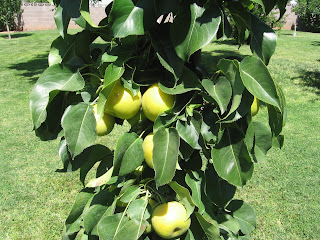
Gardening has slowed down considerably. I did harvest my O'Henry peaches, as pictured here. I also harvested our Asian pears in September. These are wonderful, round, crisp and juicy pears. My final grapes were harvested and juiced (concord). We are currently harvesting my final corn crop. We canned (froze) about half the harvest, and continue to eat this wonderful sweet corn from the garden. My fall green beans are about ready to pick, and I still harvest some tomatoes, bell peppers and Anaheim peppers.

Because of worms in the peaches the past two years, I sprayed my peaches three times after they began showing color, and did not have a single worm. The harvest of both the Elberta and O'Henry peaches was excellent for me. The only remaining fruit for me are a few Golden Delicious apples, and pomegranates. My apple tree is small and set only a few blossoms and apples.

My pomegranates are also about ripe. Last year we juiced most of our pomegranates and have enjoyed the juice all year long. I have both sweet and sour pomegranates, and when mixed with Fresca, makes a wonderful and healthy drink. I mix both sweet and sour pomegranates together, and it makes a wonderful blend for zesty drinks.
I'm looking forward to the pecan harvest this year. My trees are loaded heavily with large pecans (my harvest was quite light last year). The winds have been light, so not many have fallen prematurely to the ground. I also noticed the pecan aphids were very light this year, very little sap and drippage from the leaves.

I am already tilling my garden, tilling in corn stubble, grass clippings, chicken manure and other compostable material. All my fall leaves will also go into the garden, if tilled in, they will be completely decomposed by spring.

Because of worms in the peaches the past two years, I sprayed my peaches three times after they began showing color, and did not have a single worm. The harvest of both the Elberta and O'Henry peaches was excellent for me. The only remaining fruit for me are a few Golden Delicious apples, and pomegranates. My apple tree is small and set only a few blossoms and apples.

My pomegranates are also about ripe. Last year we juiced most of our pomegranates and have enjoyed the juice all year long. I have both sweet and sour pomegranates, and when mixed with Fresca, makes a wonderful and healthy drink. I mix both sweet and sour pomegranates together, and it makes a wonderful blend for zesty drinks.
I'm looking forward to the pecan harvest this year. My trees are loaded heavily with large pecans (my harvest was quite light last year). The winds have been light, so not many have fallen prematurely to the ground. I also noticed the pecan aphids were very light this year, very little sap and drippage from the leaves.

I am already tilling my garden, tilling in corn stubble, grass clippings, chicken manure and other compostable material. All my fall leaves will also go into the garden, if tilled in, they will be completely decomposed by spring.
Wednesday, September 1, 2010
August Gardening Report


August has been a heavy production month for me. Tomatoes, peppers, cantaloupes, casabas, watermelon, corn, and peaches. In terms of weight, August is easily the heaviest production month of the year (those melons add up in a hurry). My melons are about done producing, though I have a few cantaloupes and a few watermelons still on the vine.
A few observations and conclusions:
1. Moving my drip lines away from the base of the melons clearly helped keep the squash bugs down; I had some, but they were never much of a problem.
2. Placing a couple of drops of vegetable oil on the corn silk early in development, clearly keeps the bugs and worms out of the ear of corn.
3. I planted Striped Klondike, Crimson Sweet and Green River watermelons. The Striped Klondike were easily the best flavor, they were so sweet and delicious. Even the small Klondikes were tasty. The Green River melons were a disappointment, though I did plant them late.
4. The Ropac and Columbian tomatoes easily out-produced the Celebrity and Better Boy varieties--and they're still fairly loaded with tomatoes.
5. The casabas were disappointingly small, but good flavor, and we had more than we could eat.
6. In the past, I have not sprayed my fruit, but both previous years nearly all my peaches had worms. So this year I sprayed, only at the first sign of color. I sprayed three times, two weeks apart--and I have no worms this year. I used a vegetable safe Spectracide product.
7. My peaches (elberta) were a couple weeks later this year than last, but we did have a cool spring. But it's a great peach crop for a three year old tree. My OHenry variety ripens later, but they look good too, and I sprayed them also and see no signs of worms.
8. My pecans are also maturing later than last year. Last year in mid-August they were completely filled out, this year on September 1st, they are still not completely filled out. I have a heavy crop, and hope they still fill out large.
I planted spinach today (Sept 1st), planted green beans on August 9th, and fall corn on July 20th.
If you have empty space in your garden (have taken out completed crops), begin tilling in mulch, compost, manure, etc. The ground is a great place to compost, from now until Spring planting.
Saturday, July 31, 2010
July Gardening Report


July has been an amazingly productive month for me this year. Let me address this by crop:
Tomato: Admittedly, curly top was very light this year. A few gardeners reported some curly top, but most had none, I had none. I planted eight tomato plants, 2 Celebrity, 2 Better Boy, 2 Ropac, and 2 Columbian. During May and June I sprayed the celebrity and the Better Boy with powdered milk. I did not spray the Ropac and Columbian plants. I also sprayed my melons (cantaloupe, casaba and watermelon) with powdered milk.
None of my tomato plants contracted curly top (nor have the melons). It’s difficult to know if it had anything to do with the powdered milk, or there just weren’t any beet leafhoppers around. I did not see any leafhoppers in my garden, but they are small and difficult to see.
Consequently, my tomato harvest has been amazing. The Ropac and Columbian varieties are touted as curly top resistant (maybe they are and maybe they aren’t), but I tried both varieties. They did not contract curly top, and they were both very heavy producers. I’ve never had a tomato plant set on as heavily as these did. The tomatoes were not large, and some were quite small, but the flavor was good, and we also used them in making salsa, so the size didn’t matter.
The Celebrity variety was a bit of a disappointment in its productivity (also disappointed last year, but curly top was such a problem I dismissed it), but the tomatoes were large and tasty. The only tomatoes in my garden that had any cracking were the Celebrity tomatoes. I may try another variety next year.
The Better Boy plants(indeterminate variety) set on late, but has produced heavily, and produced some of the largest tomatoes I’ve ever grown, consistently 8 to 12 oz size.
I was tempted to plant more tomato plants this year, but know that 8 plants is far more than we and our family can use–if curly top will leave them alone. Glad I didn’t plant more. I have harvested a large bowl of tomatoes every morning for about three weeks.
Corn: I planted three plantings of corn, four rows by about 12 feet long, about three weeks apart. I planted only Miracle Corn (I really like this corn). We have had more than we can eat and have given it away to neighbors and family. I place a couple of drops of vegetable oil on the corn silk after it emerges to eliminate worms and bugs. It was less effective this year than what I experienced in the past–not sure why. Still, most ears were worm and bug free. The third planting is just getting ripe now. I also planted four full rows of corn on July 20th, for my fall crop. Miracle Corn is a 70 day corn, so we’ll be eating this crop in October. We plan to blanche, cut off the kernels, bag and freeze much of this crop.
There is no reason, in this area, that you cannot enjoy sweet corn from your garden from about July 1st through October, if you make successive plantings.
As I harvest my corn, I take a large butcher knife with me and cut off the corn stalks low, then cut up the stalk into about 6-8" pieces, and just leave them in the corn rows. When I’m finished with the crop, I till it all back into the soil. My experience is that the corn stubble is all decomposed well before I begin tilling for the spring planting.
Cantaloupe: As some of you may know, I only plant one variety, Ambrosia, easily the best flavored cantaloupe on the market. It has a short shelf life and therefore you won’t find it in the grocery stores. I planted two rows (40 feet long), and we have been buried in sweet, tasty melons.
Casaba: I have never grown casaba before, but tried it this year (I normally plant Crenshaw Melons). Casabas are a little later maturing, and have only harvested two melons so far. The size of the casaba are a bit small for some reason.
Watermelon: I planted two rows of watermelons, a row of Striped Klondike, a half row of Crimson Sweet, and a half row of Green River. The Green River seeds came from my father in law who has been dead for 15 years, every seed sprouted, however. But I planted these a little later and they are not yet ready.
The Klondike melons are looking extremely good. We’ve only eaten a couple of smaller ones that cracked open, but the flavor, even for an immature melon, was excellent.
The Crimson Sweet are also not ready yet, but will be within a week or two.
Boysenberry: I have a small everbearing strawberry patch, and several boysenberry plants. During the month of July we have enjoyed an abundant harvest of both strawberries and large, plump boysenberries. This has been a real treat for us. The boysenberries are nearly finished, however. The strawberries have been producing since April 20th.
Green Beans: This past week I also planted two rows of bush type green beans, which are sprouting today. Beans are about a 60 day crop so they should be ready by October 1st.
I plan on planting spinach about September 1st, for a winter crop.
Finally, as I observe other gardens and talk to other gardeners, I notice a couple of things:
1) Weed Control: it’s a mistake to allow weeds to grow large. They are easy to remove when small, just a couple minutes a day will keep all your weeds out. Large weeds sap nutrients, water, and space from your garden, and if allowed to go to seed, will dump hundreds or thousands of weed seeds back into your garden–a big mistake.
2) Nutrients: many gardeners fail to understand the necessity of adding nutrients back into their garden, every year, even continuously. A successful garden will take out hundreds of pounds of produce, plus the weight of the plant that it grows on; so hundreds of pounds of nutrient must be replaced. Leaves, manure, compost, grass clippings, table scraps, or any organic material can, and should, be returned to the garden. If you have a chipper or grinder, then leaves, twigs, and other carbon based materials can be ground up and returned to the garden. This is a process I engage in year round, but especially during the dormant fall and winter period. All of the above mentioned material were completely decomposed by spring. The rule of thumb is this: it takes the same amount of time for something to decompose as it did to grow. Here is my recycling program: it goes from the garden to the table, from the table to the chickens, from the chickens to the garden.
3) Variety: many gardeners do not pay attention to the variety they plant–this is a mistake. The variety affects the flavor, production, and success of your garden. Experiment a little every year and settle on the varieties that have the best flavor, are the most productive, and do the best in this area.
Thursday, July 1, 2010
June Gardening

A few observations about gardening this year.
1. Curly Top : I've seen no evidence of the beet leafhopper and the accompanying curly top virus in my tomatoes. Nor have I seen any evidence of it in any of my vines. My neighbor had one of about 20 plants infected with curly top. I've asked a few neighbors and none have had problems with the disease...yet. I continue to spray powdered milk on my tomatoes and vines. Renowned agronomist Sylvan Wittwer told me that milk is a known defense against curly top and other tomato diseases. It isn't 100%, but it is known to be effective. So the powdered milk thing is not just urban legend, but has a scientific basis. Still, it's difficult to know whether this is just an off year for the beet leafhopper, or if the milk is having an effect. I suspect the strong southwesterly winds we experienced most days in May and June may have blown the leafhoppers far away from Toquerville.
2. Tomatoes: I planted Celebrity, Better Boy, Rowpac, and Columbian varieties this year. Rowpac and Columbian are supposedly curly top resistant. All are doing well. The Rowpac and Columbian are heavy setters and are loaded with tomatoes, though their size is smaller than I like. But the flavor of both is good, and very little cracking. The Better Boy plants have not set many tomatoes this year. Witter recommends Champion or Superfantasic over this variety, I may try these next year.
3. Corn: I planted four rows of Miracle Corn. Last year this 70 day corn was on the table at 70 days; this year, however, it will be about an 85 day corn. The cool weather slowed down its growth. Still, the corn looks great and we look to be eating some within a week's time. I've mentioned this before, but I always place a couple of drops of vegetable oil on the corn silk shortly after it emerges. This eliminates the corn borer and keeps the ears clear of bugs. It's an inexpensive solution, and avoids the use of pesticides. This year I put the oil in a small squirt bottle and just shot a little squirt of oil onto the silk. It worked perfectly.
4. Melons: I planted Ambrosia cantaloupe, Casaba, Klondike watermelon, and Green River watermelon. The Green River melon seeds were some my wife's father had saved (he's been dead for 15 years), but every seed sprouted. The Ambrosia and Casaba are doing well, with good melon sets growing nicely. This year I gradually moved my drip lines away from the base of the melons (and squash). This keeps the squash bugs at bay (I have no squash bugs yet). The ground remains dry at the base of the plants, where squash bugs like to reside.
5. Onions: I have been harvesting onions for eight weeks, and have now taken the water off and am drying out the onion bulbs. This onion crop was impressive, probably the best onions I've grown. I'm trying to dry out the onions better this year so they will last longer through the winter.
6. Squash: I planted zucchini and scallop summer squash. All plants look great and are producing all too well. Again, I've seen no squash bugs yet. I also planted a "turban" squash given to me by a friend of mine. This is a large, winter squash. The plant is very large and has set several turbans.
7. Berries: I am now harvesting large, black, delicious boysenberries. This is a first for me. The plants have grown well, and are producing a nice crop. We have also been eating strawberries for over two months. My raspberries flowered thickly, but produced no fruit, very disappointing. I've had others tell me there's did the same this year, so not sure what that is about.
Overall, this has been a wonderful gardening year for me. All the cool weather crops were excellent; beets, carrots, broccoli, peas, onions. I have green beans growing, a great crop of grapes coming, and a nice crop of figs. The figs, however, are about a month behind last year. After a disappointing pecan crop last year, this year's crop looks to be very good, the trees are thick with young, small pecans. My apricots mostly froze, but are enjoying the few that survived.
Toquerville gardeners should appreciate the excellent gardening weather we have here. Two elements make the difference, in my opinion. First, although the days can get hot, Toquerville warms slowly in the summer mornings, and usually begin cooling by 1-2pm in the afternoon. So there is really only a few hours of hot temperatures. Second, the evening always cool (it was 66 degrees this morning), so plants do not get significantly stressed by the summer heat. This is not typical of St George and Washington, and areas south.
Sunday, June 6, 2010
May Gardening Report
May was a spectacular month for gardening in Toquerville. Warm days and cool nights was perfect for onions, broccoli, peas, beets, carrots and tomatoes. I've never had better onions, broccoli, beets, carrots, and peas--the weather was perfect.
It's also interesting to see how much the garden changes since my last post (6 weeks ago). I have been harvesting broccoli since May 6th, green onions since May 7th, beets since May 10th, carrots since May 20th, and peas since May 22nd. And my harvest has been excellent.
My beets are about done, the peas will probably be done within a week or so. I continue to harvest flowerettes from the broccoli plants, and expect they will be ok for another couple of weeks.
But if the weather was perfect for the cool weather crops, it was not quite so good for the warm weather crops like corn, melons, peppers, cucumbers, and squash. All are doing well, they are just behind their growth from last year, due to cooler temperatues.
I have three plantings of corn however. My first planting was April 12th, second planting was May 6th, and third planting was May 26th. The first planting is nearing the tassel stage (this week I think). I planted Miracle Corn again this year, was very pleased with its performance last year, great flavor, large ears, and it doesn't blow over in the wind. With the successive plantings, we should have delicious corn for two and a half months.
The other good news (fingers crossed) is I have had no evidence of curly top. Due to the cool, wet spring weather, the beet leafhoppers have not appeared in my garden--yet. I am experimenting with two "defensive" measures. I planted both Rowpac, and Columbian varieties, both claim to be resistant to curly top. For my other two varieties (Celebrity and Better Boy), I have sprayed them with a powdered milk mixture. By this time last year, I had already lost most of my tomatoes to curly top. Last year I took no action against the disease, and had to replant most of my tomatoes, and eventually got a fair crop.

It's also interesting to see how much the garden changes since my last post (6 weeks ago). I have been harvesting broccoli since May 6th, green onions since May 7th, beets since May 10th, carrots since May 20th, and peas since May 22nd. And my harvest has been excellent.
My beets are about done, the peas will probably be done within a week or so. I continue to harvest flowerettes from the broccoli plants, and expect they will be ok for another couple of weeks.
But if the weather was perfect for the cool weather crops, it was not quite so good for the warm weather crops like corn, melons, peppers, cucumbers, and squash. All are doing well, they are just behind their growth from last year, due to cooler temperatues.
I have three plantings of corn however. My first planting was April 12th, second planting was May 6th, and third planting was May 26th. The first planting is nearing the tassel stage (this week I think). I planted Miracle Corn again this year, was very pleased with its performance last year, great flavor, large ears, and it doesn't blow over in the wind. With the successive plantings, we should have delicious corn for two and a half months.
The other good news (fingers crossed) is I have had no evidence of curly top. Due to the cool, wet spring weather, the beet leafhoppers have not appeared in my garden--yet. I am experimenting with two "defensive" measures. I planted both Rowpac, and Columbian varieties, both claim to be resistant to curly top. For my other two varieties (Celebrity and Better Boy), I have sprayed them with a powdered milk mixture. By this time last year, I had already lost most of my tomatoes to curly top. Last year I took no action against the disease, and had to replant most of my tomatoes, and eventually got a fair crop.

Friday, April 23, 2010
April Garden and Weather Report

It has been an unusual Spring, wet, cool, and frosty. I planted my tomatoes on April 2nd. On April 6th, it got down to 32 degree and froze my tomatoes, peppers, most of my apricots, and a few peaches. Admittedly, I was shocked to see frost on the ground that morning, since the weather report the night before called for a low of only 39 degrees, partly cloudy and breezy--so I was not worried. If you think Al Gore knows the weather 100 years from now, consider that between 10:30 pm, and 8 a.m. the following morning, it cleared off, there was no breeze and it froze--the weather report was off considerably.
Even with the unusual weather, it is still a great spring for gardening, lots of rain (8.45 inches of rain at my house since Jan 1st), cool temps, and not much wind.
My onions, peas, beets and carrots are loving this spring of 2010. I replanted my tomatoes and peppers, and planted Miracle Corn on April 12th, and it is now up. I also planted Ambrosia Cantaloupe, Casaba, and summer squash.
With the cool weather, there are not many pests yet, but the aphid are showing up on my peach tree leaves, so they will get sprayed tomorrow. I use a non-chemical mixture of Tabasco hot sauce and Dawn dish soap in a sprayer. It works very well for aphids and is non-toxic.
If you can dodge the rain and the wind, it's a good time to spray 2-4 D product on morning glory, dandelions, and other broadleaf weeds. Remember that 2-4D drifts, if it's windy, and can damage garden crops and fruit trees--even your neighbor's crops and trees, so always avoid spraying if there is any wind.
Sunday, March 21, 2010
March Gardening

January was wet, February was wet, March IS wet. Consequently, the soil is also wet, and makes it difficult to till. I was able to get my garden tilled in early February, and got a few cool crops planted in mid-late February. But I have been unable to till the garden since--just too wet.
Toquerville has received almost 8 inches of rain since January 1st, already above our annual average rainfall. And with the El Nino pattern, it will probably continue wet well into May. But the El Nino pattern also means we will have fewer strong, north winds, and we have had fewer strong north winds than the past three years. So young, tender garden plants will not get beat up so badly from the wind. And I have not yet needed to water either my garden, grass or trees. I would suggest that because the soil is so saturated, to be careful about watering just because it warms up. I doubt trees will need any water for some time yet.
I have onions, peas, beets, carrots, and broccoli up and growing. Your cool weather crops should be in by now.
March Checklist:
1. Cool weather crops should be in the ground by now.
2. Roses should be pruned
3. Fertilize (spikes or granular) fruit trees, berries, shrubs
4. Till garden as soon as it dries out sufficiently, for planting tomatoes, potatoes, summer squash, melons, corn, etc.
5. Setup your drip system, this picture shows mine. I have my drip on a timer so I know the garden always gets watered, even if I forget about it, or am out of town.
6. Be thinking about Curly Top, and how you're going to combat it. I am going to plant some resistant varieties this year. See my earlier posts in this blog for a more complete treatment of this subject. It's been a wet winter and spring, so the Beet Leafhopper will be abundant this year.
Consider fertilizing your garden with a water soluble fertilizer through your drip system. Monoamonium Phosphate is what I use. Ballards Nursery sells this fertilizer, it is a low nitrogen, high phosphate, water soluble fertilizer, and I dispense it through my drip system. This fertilizer comes in a 50 lb bag, but will last you two or three years, or more.
Monday, February 8, 2010
Spring Garden Guide
Spring is not far away and it’s time to begin planning your spring garden. This January and February have been cooler than last year (A year ago, it was 65 degrees on Feb 8th), so I’m holding off planting for a bit, plus my garden is too wet to work.
A Few Tips
1. Don’t till your garden while the soil is sticky wet, wait until it dries a bit. If the soil sticks together, you will have hard, dirt clods for a good while. If it’s too wet, which mine is right now, just wait a few days, let the wind and the sun dry it out a bit. Toquerville has had 4.5 inches of rain the past three weeks. That’s a lot of water, let the soil dry out.
2. It’s still not too late to till in leaves or other compost material, but get it in the ground. A few weeks of sun and additional tilling, and it will be broken down nicely. Here’s a rule of thumb: it takes as long to compost a material as it did to grow it. So if you have two year old sticks in the garden, it will take two years to break it all down. Leaves? They are out and grown to size in a matter of weeks, so a few weeks of leaves in the ground, and they’re done. If you tilling in now, plant your early garden in another spot, and plant your later crops where you’re now mulching in compost material.
3. Plant what you eat. It doesn’t make sense to grow things because they’re easy (like radishes), if you don’t like radishes, then try to push them off onto your neighbors.
4. Grow only the quantity of a crop you and your family can eat, or give to family and neighbors. Remember your neighbors are also gardening (probably), so go easy on the quantity. It’s better to grow a wide variety of crops, in small amounts you can eat, than to grow a lot of zucchini (for example) that you can’t give away. A full row of zucchini will feed the entire town, but several rows of melons will go fast.
5. Nearly all crops do best, produce the best fruit, best flavor, best size, etc, when they grow fast. So if you plant early and the temperature stays cold, they won’t grow much, but will sit in the ground, waiting for birds to eat them down.
6. Planting onions from seed can be tricky to obtain a good germination. When I plant seed, I cover with white plastic until they germinate, it works well. But I prefer planting the small dry sets, every set grows, they get growing faster, and still reach a nice size. Plant sets with the bottom down. Sets are fail proof.
7. Fruit trees should be pruned by now.
Crops To Plant Now
The following crops can be planted now, and for the next couple of months. If the garden can be worked, isn’t too wet, and it warms up a bit, these crops will grow in cool weather:
1. Peas – can go in the ground anytime now
2. Broccoli – wait a couple of weeks, plant sets deep to avoid wind damage
3. Carrots – wait until it warms a bit, they’ll germinate better (a week or two)
4. Beets – wait until it warms a bit (a week or two)
5. Onions – can go in the ground anytime now
6. Spinach – can go in the ground anytime (I’m harvesting spinach I planted in late August)
7. Lettuce – wait until it warms a bit, and protect it from birds
Keep in mind the birds are hungry right now, and until things green up, they will be looking at your garden as food for them.
Plant In April-May (just wait until temperatures are in the 65-75 range)
1. Tomato
2. Potato
3. Corn
4. Melons
5. Squash
Varieties of Preference
I believe in planting the right varieties, varieties with the best flavor, that do well in this climate, and that provide good production. Here are my preferences:
1. Corn = Miracle Corn (great flavor, 70 day maturity, doesn't blow over
2. Tomato = Celebrity, Better Boy, Floramerica (hard to find), great slicing tomato. Rowpac, Columbia and Salad Master all claim to be resistant to the Curly Top virus.
3. Cantaloupe = Ambrosia, by far the best flavored cantaloupe on the market. This variety has a poor shelf life, so you will never find it in the grocery store, so you must grow your own.
4. Beets = Ruby Queen, or Detroit Dark. Both varieties do well.
5. Onions = Sweet Spanish. I grow onions to last through the winter, Sweet Spanish is a good flavored onion, and will last through the winter. Sweeter varieties like Walla Walla, and Texas, do not store well, but have nice flavor.
6. Watermelon = I had good success with the Crimson Sweet, but haven't really tried other varieties. Melons were flavorful, good size, and disease resistant.
7. Squash = I grew zucchini, crookneck, spaghetti, and Toquer Squash with good success
8. Crenshaw melons and Casaba melons do well here, get them in early (April-May) and enjoy them all summer
A Few Tips
1. Don’t till your garden while the soil is sticky wet, wait until it dries a bit. If the soil sticks together, you will have hard, dirt clods for a good while. If it’s too wet, which mine is right now, just wait a few days, let the wind and the sun dry it out a bit. Toquerville has had 4.5 inches of rain the past three weeks. That’s a lot of water, let the soil dry out.
2. It’s still not too late to till in leaves or other compost material, but get it in the ground. A few weeks of sun and additional tilling, and it will be broken down nicely. Here’s a rule of thumb: it takes as long to compost a material as it did to grow it. So if you have two year old sticks in the garden, it will take two years to break it all down. Leaves? They are out and grown to size in a matter of weeks, so a few weeks of leaves in the ground, and they’re done. If you tilling in now, plant your early garden in another spot, and plant your later crops where you’re now mulching in compost material.
3. Plant what you eat. It doesn’t make sense to grow things because they’re easy (like radishes), if you don’t like radishes, then try to push them off onto your neighbors.
4. Grow only the quantity of a crop you and your family can eat, or give to family and neighbors. Remember your neighbors are also gardening (probably), so go easy on the quantity. It’s better to grow a wide variety of crops, in small amounts you can eat, than to grow a lot of zucchini (for example) that you can’t give away. A full row of zucchini will feed the entire town, but several rows of melons will go fast.
5. Nearly all crops do best, produce the best fruit, best flavor, best size, etc, when they grow fast. So if you plant early and the temperature stays cold, they won’t grow much, but will sit in the ground, waiting for birds to eat them down.
6. Planting onions from seed can be tricky to obtain a good germination. When I plant seed, I cover with white plastic until they germinate, it works well. But I prefer planting the small dry sets, every set grows, they get growing faster, and still reach a nice size. Plant sets with the bottom down. Sets are fail proof.
7. Fruit trees should be pruned by now.
Crops To Plant Now
The following crops can be planted now, and for the next couple of months. If the garden can be worked, isn’t too wet, and it warms up a bit, these crops will grow in cool weather:
1. Peas – can go in the ground anytime now
2. Broccoli – wait a couple of weeks, plant sets deep to avoid wind damage
3. Carrots – wait until it warms a bit, they’ll germinate better (a week or two)
4. Beets – wait until it warms a bit (a week or two)
5. Onions – can go in the ground anytime now
6. Spinach – can go in the ground anytime (I’m harvesting spinach I planted in late August)
7. Lettuce – wait until it warms a bit, and protect it from birds
Keep in mind the birds are hungry right now, and until things green up, they will be looking at your garden as food for them.
Plant In April-May (just wait until temperatures are in the 65-75 range)
1. Tomato
2. Potato
3. Corn
4. Melons
5. Squash
Varieties of Preference
I believe in planting the right varieties, varieties with the best flavor, that do well in this climate, and that provide good production. Here are my preferences:
1. Corn = Miracle Corn (great flavor, 70 day maturity, doesn't blow over
2. Tomato = Celebrity, Better Boy, Floramerica (hard to find), great slicing tomato. Rowpac, Columbia and Salad Master all claim to be resistant to the Curly Top virus.
3. Cantaloupe = Ambrosia, by far the best flavored cantaloupe on the market. This variety has a poor shelf life, so you will never find it in the grocery store, so you must grow your own.
4. Beets = Ruby Queen, or Detroit Dark. Both varieties do well.
5. Onions = Sweet Spanish. I grow onions to last through the winter, Sweet Spanish is a good flavored onion, and will last through the winter. Sweeter varieties like Walla Walla, and Texas, do not store well, but have nice flavor.
6. Watermelon = I had good success with the Crimson Sweet, but haven't really tried other varieties. Melons were flavorful, good size, and disease resistant.
7. Squash = I grew zucchini, crookneck, spaghetti, and Toquer Squash with good success
8. Crenshaw melons and Casaba melons do well here, get them in early (April-May) and enjoy them all summer
Thursday, November 5, 2009
Season's End
On October 30th, Toquerville got some frost, and pretty much ended my gardening. I picked the last of my green beans the night before, and picked the rest of my tomatoes. I still have beets, carrots and spinach we continue to enjoy. Though we have not had a freeze yet, my garden has pretty much stopped growing. Last year, our first freeze came on October 12th, but after that, it didn't freeze again until December 5th. But length of day, and soil temperatures are such that plants will no longer do much growing. This spring, temperatures did not warm until about mid-April.
I have tilled up my garden, tilled in a few leaves, grass clippings, and some manure I brought in. I also tilled in a large bale of straw in an area of my garden which is heavier and has more clay. Now is the time to get compost working in your garden. Come planting time in the spring, your straw, leaves, and other material will all be broken down and fully composted.
Season Summary
It was a wet winter and spring, so the beet leaf hopper was particularly bad and affected everyone's tomatoes, potatoes, and nearly all vines. The leaf hopper population is dependent on the weather, the wetter the winter and spring, the higher the leaf hopper population; the drier the winter and spring, the lower the leaf hopper population. Still, even a low leaf hopper population can wreak havoc with your garden. I avoid using pesticides, but may have to do more next year to fight the leaf hopper.
I felt I had a successful garden, but some crops were better than others. My corn was great, cantaloupes, crenshaw, and watermelon were all good, but diseases hurt quality and production. Beets, carrots, broccoli, onions, and squash were all very good for me.
My observations are these: I will plant a bit later in the spring than in the past, to try to avoid the beet leafhopper, hard winds, and cold temperatures. I probably won't do much before April 1st. I put in a drip watering system this spring. I like it, conserves water, works off my timer, and allows me to work in the garden while I am watering.
Varieties of Preference
I believe in planting the right varieties, varieties with the best flavor, that do well in this climate, and that provide good production. Here are my preferences
1. Corn = Miracle Corn (great flavor, 70 day maturity, doesn't blow over
2. Tomato = Celebrity, Better Boy, Floramerica (hard to find), great slicing tomato. I may have to consider varieties resistant to the blight.
3. Cantalooupe = Ambrosia, by far the best flavored cantaloupe on the market. This variety has a poor shelf life, so you will never find it in the grocery store, so you must grow your own.
4. Beets = Ruby Queen, or Detroit Dark. Both varieties do well.
5. Onions = Sweet Spanish. I grown onions to last through the winter, Sweet Spanish is a good flavored onion, and will last through the winter. Sweeter varieties like Walla Walla, and Texas, will not last through the winter.
6. Watermelon = I had good success with the Crimson Sweet, but haven't really tried other varieties. Melons were flavorful, good size, and disease resistant.
7. Squash = I grew zucchini, crookneck, spaghetti, and Toquer Squash with good success
Garden Basics
1. Your garden success is only as good as your soil, add humus, compost, fertilizer, and other soil conditioners now until the ground freezes.
2. Determine the varieties you want to plant next year, and make sure you can find those varieties come planting time. 2009 was perhaps one of the most active gardening seasons in years--and nurseries and garden centers ran out of a lot of seeds, so buy early.
3. Weeds, even winter weeds, harbor pests, sap nutrients from your soil, and multiply faster than you can say Jack Sprat. So keep weeds out of your entire yard.
4. Fall and winter is a good time to service your tiller, lawnmower, weed eater, and other equipment; clean air filters, check oil levels, and do general cleaning of the equipment.
5. Pruning can be done at anytime, but pruning in the spring, just before fruit trees bloom, is the ideal time. Allow the trees to take the strength from the leaves and branches, down into the roots, then prune in the spring.
I have tilled up my garden, tilled in a few leaves, grass clippings, and some manure I brought in. I also tilled in a large bale of straw in an area of my garden which is heavier and has more clay. Now is the time to get compost working in your garden. Come planting time in the spring, your straw, leaves, and other material will all be broken down and fully composted.
Season Summary
It was a wet winter and spring, so the beet leaf hopper was particularly bad and affected everyone's tomatoes, potatoes, and nearly all vines. The leaf hopper population is dependent on the weather, the wetter the winter and spring, the higher the leaf hopper population; the drier the winter and spring, the lower the leaf hopper population. Still, even a low leaf hopper population can wreak havoc with your garden. I avoid using pesticides, but may have to do more next year to fight the leaf hopper.
I felt I had a successful garden, but some crops were better than others. My corn was great, cantaloupes, crenshaw, and watermelon were all good, but diseases hurt quality and production. Beets, carrots, broccoli, onions, and squash were all very good for me.
My observations are these: I will plant a bit later in the spring than in the past, to try to avoid the beet leafhopper, hard winds, and cold temperatures. I probably won't do much before April 1st. I put in a drip watering system this spring. I like it, conserves water, works off my timer, and allows me to work in the garden while I am watering.
Varieties of Preference
I believe in planting the right varieties, varieties with the best flavor, that do well in this climate, and that provide good production. Here are my preferences
1. Corn = Miracle Corn (great flavor, 70 day maturity, doesn't blow over
2. Tomato = Celebrity, Better Boy, Floramerica (hard to find), great slicing tomato. I may have to consider varieties resistant to the blight.
3. Cantalooupe = Ambrosia, by far the best flavored cantaloupe on the market. This variety has a poor shelf life, so you will never find it in the grocery store, so you must grow your own.
4. Beets = Ruby Queen, or Detroit Dark. Both varieties do well.
5. Onions = Sweet Spanish. I grown onions to last through the winter, Sweet Spanish is a good flavored onion, and will last through the winter. Sweeter varieties like Walla Walla, and Texas, will not last through the winter.
6. Watermelon = I had good success with the Crimson Sweet, but haven't really tried other varieties. Melons were flavorful, good size, and disease resistant.
7. Squash = I grew zucchini, crookneck, spaghetti, and Toquer Squash with good success
Garden Basics
1. Your garden success is only as good as your soil, add humus, compost, fertilizer, and other soil conditioners now until the ground freezes.
2. Determine the varieties you want to plant next year, and make sure you can find those varieties come planting time. 2009 was perhaps one of the most active gardening seasons in years--and nurseries and garden centers ran out of a lot of seeds, so buy early.
3. Weeds, even winter weeds, harbor pests, sap nutrients from your soil, and multiply faster than you can say Jack Sprat. So keep weeds out of your entire yard.
4. Fall and winter is a good time to service your tiller, lawnmower, weed eater, and other equipment; clean air filters, check oil levels, and do general cleaning of the equipment.
5. Pruning can be done at anytime, but pruning in the spring, just before fruit trees bloom, is the ideal time. Allow the trees to take the strength from the leaves and branches, down into the roots, then prune in the spring.
Tuesday, October 6, 2009
The Fall Garden
My summer garden is about done. I just finished my second crop of sweet corn. Again, I've never grown better corn, and yes, I'm still sold on Miracle Corn, my new variety of choice. The corn's flavor is superb, large ears, and matures in about 70 days. The corn grows only about 6ft tall, thus resists lodging during strong winds. And it pollinates very successfully, even on the edges of the crop. I'm also sold on placing a couple of drops of vegetable oil on the silk, shortly after it appears--this prevents worms and bugs from entering the ear of corn. It is 100% successful, if applied in a timely manner. The result? perfect ears of corn with no worms or bugs.
I currently have tomatoes, green beans, beets, carrots, and spinach in my garden. We ate our first green beans yesterday, are enjoying a late tomato crop, and have harvested some spinach. The beans were planted July 18th, the spinach and beans were planted on August 10th. I should have beets ready later in October. Other falls crops can also be planted; broccoli, lettuce, cabbage, and other cool weather crops.
I have applied a load of manure on the greater part of the, now unused, garden soil, and tilled it in. I will also till in large quantities of leaves as soon as they come down. Fall is the time to prepare the garden for spring planting. You took a lot out of your garden, you need to put a lot back. Manure, leaves, compost, sawdust, any biodegradable material should be tilled into your garden.
I tend not to want to pay for the manure I put in my garden, so I ask around and find horse owners, or other folks with animals, and ask if I can relieve them of some of their manure (they are always anxious to get rid of some of that stuff). Some with tractors and loaders will even load my truck for me, so all I have to do is empty the truck and place it in my garden. Chicken and Turkey manure is too hot for the garden, but if mixed with other material (leaves, sawdust, etc) it becomes a great garden fertilizer. I prefer horse manure, it isn't too hot (nitrogen content), and horse owners tend to buy the best hay, with few weeds, so I "import" fewer weeds than with cow manure.
I currently have tomatoes, green beans, beets, carrots, and spinach in my garden. We ate our first green beans yesterday, are enjoying a late tomato crop, and have harvested some spinach. The beans were planted July 18th, the spinach and beans were planted on August 10th. I should have beets ready later in October. Other falls crops can also be planted; broccoli, lettuce, cabbage, and other cool weather crops.
I have applied a load of manure on the greater part of the, now unused, garden soil, and tilled it in. I will also till in large quantities of leaves as soon as they come down. Fall is the time to prepare the garden for spring planting. You took a lot out of your garden, you need to put a lot back. Manure, leaves, compost, sawdust, any biodegradable material should be tilled into your garden.
I tend not to want to pay for the manure I put in my garden, so I ask around and find horse owners, or other folks with animals, and ask if I can relieve them of some of their manure (they are always anxious to get rid of some of that stuff). Some with tractors and loaders will even load my truck for me, so all I have to do is empty the truck and place it in my garden. Chicken and Turkey manure is too hot for the garden, but if mixed with other material (leaves, sawdust, etc) it becomes a great garden fertilizer. I prefer horse manure, it isn't too hot (nitrogen content), and horse owners tend to buy the best hay, with few weeds, so I "import" fewer weeds than with cow manure.
Monday, August 17, 2009
Squash Bugs

Nothing is quite as ugly, smelly and destructive as squash bugs. Squash bugs, Anasa tristis, are a difficult garden pest to control, but there are options. Squash bugs prefer yellow crookneck summer squash, and they prefer this variety over zucchini and other squashes, although I don't find them very discriminating. They also favor pumpkins, and spaghetti squash.
 Squash bugs will thrive in, on, under, and around all squash plants, melons, pumpkins, cucumbers, and all cucurbits.
In my garden they seemed to favor the squash (crookneck and spaghetti), and avoided watermelon. Since my watermelons turned out quite good,
 I may plant more watermelon next year.
Sylvan Wittwer suggested to me, to use drip lines, and as the plants grow, move the lines further away from the plant base. Squash bugs like moist areas around the base of the plants, so removing the moisture from that area greatly reduces the attractiveness of the plant base. So this year, with a drip system installed, I tested this theory. My first row of garden, next to the lawn, had a Toquer Squash, a pumpkin, and a spaghetti squash. This was my control because it got overspray from the lawn sprinklers and the base of the plants were usually damp.
The remaining rows of cantaloupe, crenshaw melons, crookneck, zucchini, watermelon, and spaghetti squash, received the benefit of my moving the drip lines away from the base of the plants, as the plants grew. The drip lines ended up about 1 ft away from the base of the plants.
Clearly, the squash bugs preferred the first row of vines that tended to remain damp from the lawn overspray. Some of the other rows of melons, etc, where the base remained dry and open to the sun, squash bugs were much less prominent. So this does help--but the bugs will still come, they just won't be as "happy" and don't seem to reproduce nearly as fast in the dry conditions.
In addition to the above cultural practice, I also did the following:
1. Each day, I would scour the vine leaves for the eggs of the squash bugs, and squish these with my fingers. I was interested that the bugs laid eggs both under the leaves, and on top of the leaves. As the garden got bigger (quite a few melons), examining all the leaves became a bit of a chore, but I still tried to spend a few minutes each day looking for eggs, and eliminating them before they hatched.
2. I would also lift up the ends of the squash plants, every morning, and look for bugs, and squish them on the spot. This works well with the crookneck because you can lift up each vine all the way back to the base and see the bugs, and get rid of them. If you're squeamish, wear gloves.
3. Later in the summer, the squash bugs will accumulate under and on the fruit of the plants. As the foliage of the plants deteriorates through the summer, they will begin eating the squash, melons or pumpkins, etc. So I would lift or turn each squash (spaghetti), melon (cantaloupe and crenshaw) and expose the bugs, and squish them enmasse.
Historically, pesticides are not effective against adult squash bugs, and sprays or powders must be sprayed on the under side of plants and leaves to get to where the bugs are, and this is difficult to do. I do not even attempt to spray for squash bugs, and I tend to avoid using pesticides generally.
Strong, healthy, vigorous plants will withstand the effects of squash bugs better than weak or less thriving plants, so this should always be strived for. My experience is, doing nothing is not a good option--the bugs will win, your plants will lose, and you won't get much production.
Sunday, August 2, 2009
Mid-Summer Report
Corn
 The Miracle Corn I planted in May was a huge success. It was easily the best corn crop I've ever grown. I really liked the variety, large stalks, large leaves, not too tall (6 ft), two large ears per stalk, full rows of kernels, great flavor.
You'll notice in this picture there are no worms. I treat the newly emerged silk with two drops of vegetable oil, which prevents worms and other bugs from entering the growing ears. This is an easy, non-pesticide method that works 100%.
This crop is finished, but I have a fall crop of Miracle Corn on the way.
way.
Watermelon
I have never had success growing watermelon, but thought I'd give it another try in Toquerville. I planted Crimson Sweet, and this melon was the first one I harvested, about 20 lbs, the flavor was very good, juicy, and I'll probably grow watermelon again, although I think I'll try the seedless variety next year.
Onions
I harvested my Sweet Spanish onions, had an excellent crop, with nice medium sized onions. I'm not satisfied with my drying methods yet. I have tried laying them on the ground, in the shade. This worked pretty well, but you have to keep turning and moving the onions until the tops are completely dried. I have tried tying the leaves together over a line, in the shade. This worked pretty well too, but they would sometimes fall down, or blow down if there was a strong wind, and squirrels or animals would take them. This year I tried pulling them and just leaving them on the ground (dry ground). This worked ok for some of the onions, but too high a percentage "cooked" and were spoiled by the sun.
Cantaloupes
We have been eating cantaloupes for a month. I plant only Ambrosia cantaloupes, by far the best flavor of any cantaloupe, but they have a very short shelf life (which is why you won't find them in any grocery store). The cantaloupes are not as large this year, as last, but still of normal size and excellent flavor. Curly Top killed about a third of my cantaloupe plants.
Summer Squash
My zucchini, crookneck and spaghetti squash all produced well. The curly top took both my zucchini plants, and both my crookneck plants, but I replanted both and have not been without summer squash yet. Quality has been excellent.
Pumpkin
Curly Top killed my one pumpkin plant, but we still got three pumpkins off it before it was gone.
Potatoes
The Curly Top eventually got to all my potato plants, but I still got a fair harvest, the potatoes just did not get as large as they should. The red potatoes did much better than the white "gold" variety. We've been enjoying the potatoes, and the flavor is very good, potatoes are just small.
Toquer Squash
I have a Toquer Squash vine growing in my garden that has become very large, spreading far and wide (I was warned it would do this). It contains several large, maturing bell shaped squash, and does not appear to be affected by Curly Top. When mature, this squash weighs 20-30 pounds. I got these seeds from my neighbor who grows the squash also. I'm impressed with the sweetness and flavor of this squash, plus it being a winter squash, should store well for some time.
Curly Top
Curly Top has damaged my tomatoes, potatoes, spinach, squash, pumpkin, cantaloupe, crenshaw melons, pumpkin, and cucumbers. Harris Seed is sending me a sample bottle of "GreenCure" which is effective against all blights (Curly Top is a blight), but they don't guarantee it. I am going to try it next spring. I am unwilling to give into the widespread damage of Curly Top. If anyone has experience with "GreenCure," I'd love to hear about it.
 The Miracle Corn I planted in May was a huge success. It was easily the best corn crop I've ever grown. I really liked the variety, large stalks, large leaves, not too tall (6 ft), two large ears per stalk, full rows of kernels, great flavor.
You'll notice in this picture there are no worms. I treat the newly emerged silk with two drops of vegetable oil, which prevents worms and other bugs from entering the growing ears. This is an easy, non-pesticide method that works 100%.
This crop is finished, but I have a fall crop of Miracle Corn on the
 way.
way.Watermelon
I have never had success growing watermelon, but thought I'd give it another try in Toquerville. I planted Crimson Sweet, and this melon was the first one I harvested, about 20 lbs, the flavor was very good, juicy, and I'll probably grow watermelon again, although I think I'll try the seedless variety next year.
Onions
I harvested my Sweet Spanish onions, had an excellent crop, with nice medium sized onions. I'm not satisfied with my drying methods yet. I have tried laying them on the ground, in the shade. This worked pretty well, but you have to keep turning and moving the onions until the tops are completely dried. I have tried tying the leaves together over a line, in the shade. This worked pretty well too, but they would sometimes fall down, or blow down if there was a strong wind, and squirrels or animals would take them. This year I tried pulling them and just leaving them on the ground (dry ground). This worked ok for some of the onions, but too high a percentage "cooked" and were spoiled by the sun.
Cantaloupes
We have been eating cantaloupes for a month. I plant only Ambrosia cantaloupes, by far the best flavor of any cantaloupe, but they have a very short shelf life (which is why you won't find them in any grocery store). The cantaloupes are not as large this year, as last, but still of normal size and excellent flavor. Curly Top killed about a third of my cantaloupe plants.
Summer Squash
My zucchini, crookneck and spaghetti squash all produced well. The curly top took both my zucchini plants, and both my crookneck plants, but I replanted both and have not been without summer squash yet. Quality has been excellent.
Pumpkin
Curly Top killed my one pumpkin plant, but we still got three pumpkins off it before it was gone.
Potatoes
The Curly Top eventually got to all my potato plants, but I still got a fair harvest, the potatoes just did not get as large as they should. The red potatoes did much better than the white "gold" variety. We've been enjoying the potatoes, and the flavor is very good, potatoes are just small.
Toquer Squash
I have a Toquer Squash vine growing in my garden that has become very large, spreading far and wide (I was warned it would do this). It contains several large, maturing bell shaped squash, and does not appear to be affected by Curly Top. When mature, this squash weighs 20-30 pounds. I got these seeds from my neighbor who grows the squash also. I'm impressed with the sweetness and flavor of this squash, plus it being a winter squash, should store well for some time.
Curly Top
Curly Top has damaged my tomatoes, potatoes, spinach, squash, pumpkin, cantaloupe, crenshaw melons, pumpkin, and cucumbers. Harris Seed is sending me a sample bottle of "GreenCure" which is effective against all blights (Curly Top is a blight), but they don't guarantee it. I am going to try it next spring. I am unwilling to give into the widespread damage of Curly Top. If anyone has experience with "GreenCure," I'd love to hear about it.
Monday, July 13, 2009
Summer Corn

On May 9th, I planted four rows of Miracle Corn, on July 13th (70 days), I harvested the first ears...and was it ever tasty.
Miracle Corn is a hybrid derived from Golden Jubilee, my previous favorite corn, that has twice the lysine and tryptophan (proteins) of other corn varieties. Miracle was developed to fight malnutrition in third world countries. It's a relatively new corn, being available for only the past few years.
I have had difficulty the past few years getting two, large, full ears of corn on each stalk; Miracle corn delivered for me this year, however. Frankly, I was impressed. I h
 ave never seen better corn in the field, and its flavor is impressive. Miracle is supposed to hold its sugar longer before turning to starch, than other varieties, as well.
Beginning early last fall, I tilled in large amounts of mulch and leaves, then applied mono-ammoniumphosphate every two to three weeks through my drip system. At 30 days from planting, I "turned" the furrow against the young corn and applied a side dressing of 16-16-16.
When the silk appeared, I applied two drops of vegetable oil to the silk, using an eyedropper. This prevents worms and bugs from entering the ear of corn, giving full, clean, worm free, ears, without using pesticides. Stalks grow about 6 ft high.
I plan on a second planting towards the end of July, same variety, different location in the garden.
Wednesday, July 1, 2009
Potatoes
I have updated my June 23rd post with additional information regarding curly top and tomatoes. But curly top also infects potatoes as well as other garden plants. Indeed, variety seems to be important in fighting curly top.
Potatoes
I have two rows of potatoes, planted from seed potatoes. I have observed that the red potatoes are virtually unaffected by curly top, but the white (actually gold) potatoes are largely infected and dying. I am harvesting some nice "new" potatoes from these dying plants, but fear I will not get many mature ones.
Melons
It is also my observation, to date, that Crenshaw Melons are not affected by curly top, but Ambrosia Cantaloupes are, somewhat. The effect on Ambrosia is not significant, but has taken two of my plants.
Squash
In my garden, this year, my Crookneck Summer Squash was completely taken by curly top, but my Zucchini is unaffected.
My Spaghetti Squash, Big Max Pumpkin, and Toquer Squash are, so far, unaffected by curly top.
Cucumber
The cucumber I planted early, all died, presumably from curly top, but cucumber I planted later, are so far unaffected, and are thriving.
Potatoes
I have two rows of potatoes, planted from seed potatoes. I have observed that the red potatoes are virtually unaffected by curly top, but the white (actually gold) potatoes are largely infected and dying. I am harvesting some nice "new" potatoes from these dying plants, but fear I will not get many mature ones.
Melons
It is also my observation, to date, that Crenshaw Melons are not affected by curly top, but Ambrosia Cantaloupes are, somewhat. The effect on Ambrosia is not significant, but has taken two of my plants.
Squash
In my garden, this year, my Crookneck Summer Squash was completely taken by curly top, but my Zucchini is unaffected.
My Spaghetti Squash, Big Max Pumpkin, and Toquer Squash are, so far, unaffected by curly top.
Cucumber
The cucumber I planted early, all died, presumably from curly top, but cucumber I planted later, are so far unaffected, and are thriving.
Tuesday, June 23, 2009
Curly Top and the Beet Leafhopper

Because of the seriousness of the curly top blight in local gardens (actually throughout the Western United States), I have researched the subject and provide the following information.
This top picture is of a healthy tomato plant from my garden.
The second picture is of a Curly Top infected tomato from my garden
General Information
Causal Agent: Beet Curly Top Virus (BCTV) Hosts: Tomatoes, beans, pepper, spinach, beets, and cucumbers.
Symptoms: Lea
 ves of infested plants are dwarfed, crinkled, rolled inward, and cupped upward. Veins on the underside of leaves usually have a purple discoloration, may be roughened, and often produce swellings or spine-like outgrowths. Roots are stunted and may exhibit a proliferation of secondary rootlets.
BCTV is transmitted to/from plant to plant by the beet leafhopper, Circulifer tenellus. Both the virus and the beet leafhopper have very wide host ranges. Once acquired by the leafhopper, BCTV is carried for the rest of the leafhopper's life, and thus long distance spread is common. Infected plants are usually scattered in a field. The beet leafhopper acquires the virus from infected crop plants or weeds such as wild mustard and Russian thistle. Only brief feeding periods (minutes) are required for the leafhopper to acquire the virus and transmit it to new plants. Plants begin to show symptoms about 7 to 14 days after they are first infected by a leafhopper. Tomato is not a preferred host for the beet leafhopper; however the leafhoppers transmit the virus to tomatoes while sampling it.
Curly Top facts
a. Curly Top is a blight transmitted by the Beet Leafhopper. Although tomatoes are not its preferred host, leafhoppers are fairly indiscriminate, and tomatoes get infected along with beets, beans, melons, squash, potatoes, spinach, peppers, cucumbers and other garden plants. Even Pumpkins have been infected in some states.
b. When humidity is above 50%, Curly Top is nonexistent; thus the desert southwest is very susceptible to this disease.
c. There is no cure, once infected, the plant fails to thrive, will not set additional fruit, and will usually die. Remaining fruit will be of low quality, underdeveloped, and of poor quality and flavor.
What Doesn’t Work
a. Spraying for the Beet Leafhopper is ineffective since the Leafhopper migrates, usually coming down from hillsides as the weather warms. And although spraying will kill the leafhopper, the damage is done before the leafhopper dies.
b. Commercially, there are some insecticide spraying programs, and soil treatments that are effective, but for the home gardener, they are either not available or impractical.
c. Some of the cultural practices of commercial farmers, are also impractical or irrelevant to the home gardener. For example, planting large, thick fields of tomatoes seems to repel the Leafhopper, but gardeners can’t do this.
d. The State of California is investigating the introduction of predators and parasites for control of Beet Leafhopper, but to date, no solution has been found.
e. Covering tomatoes with a mesh or screen to keep the leafhoppers out. Most mesh is not tight enough to keep the leafhopper out, and if it is tight enough, the mesh will also keep out sunlight and create too much shading, and stunt plant growth.
What Might Work
a. There are possibly two or three resistant varieties, but all tomato varieties are susceptible. Ropac and Columbia seem to be resistant, but no immune, to curly top. Floramerica is another variety reported to be resistant, though it's not been confirmed in our area. Bruce Church in Hurricane experiences about 80% success with Ropac and Columbia.
b. Planting tomatoes later in the season, for the Hurricane Valley this would be mid-May to mid-June. Leafhoppers seem to be less prevalent by this date, and moved on to their more favored plants like Russian Thistle, Mustard, and other weeds.
c. Creating dense stands of tomatoes seems to repel the leafhopper, but for most home gardeners, this is impractical. Still, if you can plant in a square instead of a row, you will probably create some protection against the leafhopper.
d. Eliminating Russian Thistle, plantain, and other weeds is also somewhat effective, since the Leafhopper prefers weeds, particularly the Russian Thistle.
e. Creating an enclosed, clear plastic “greenhouse” over the tomatoes, for the early growing period, in theory, should protect the tomatoes from the Leafhopper, but the “greenhouse” must be tight as to make it impenetrable by the Leafhopper. If this can be maintained until mid-May, when it would probably be impracticable and inadvisable to keep the tomatoes inside the “greenhouse.”
f. Shading, which lowers light intensity and retards evaporation, probably delays leafhopper visits, decreases the infection rate, and reduces symptom expression. However, tomatoes do not like being shaded (they prefer full sun), so there is an adverse affect to this practice.
g. New Mexico State University has tested the use of applying a white kaolin mineral product (3% kaolin suspension) on tomatoes and peppers, and the treatment has proven effective against curly top. But row irrigation or drip irrigation must be used since sprinklers and rain will wash the kaolin off the plant and eliminate its effectiveness. Kaolin is a soft, earthy, usually white mineral...and don't ask me where you get Kaolin. It is probably available someplace.
h. Bruce Church in Hurricane says a spray of reconstituted dry milk is effective (From Utah State info), and he uses it. Dr. Sylvan Wittwer confirmed to me that milk is effective as both a repellent of the leafhopper and as an infection preventative. I tried this only one year and it was effective.
Subscribe to:
Posts (Atom)